Safe Work Method Statement (SWMS)
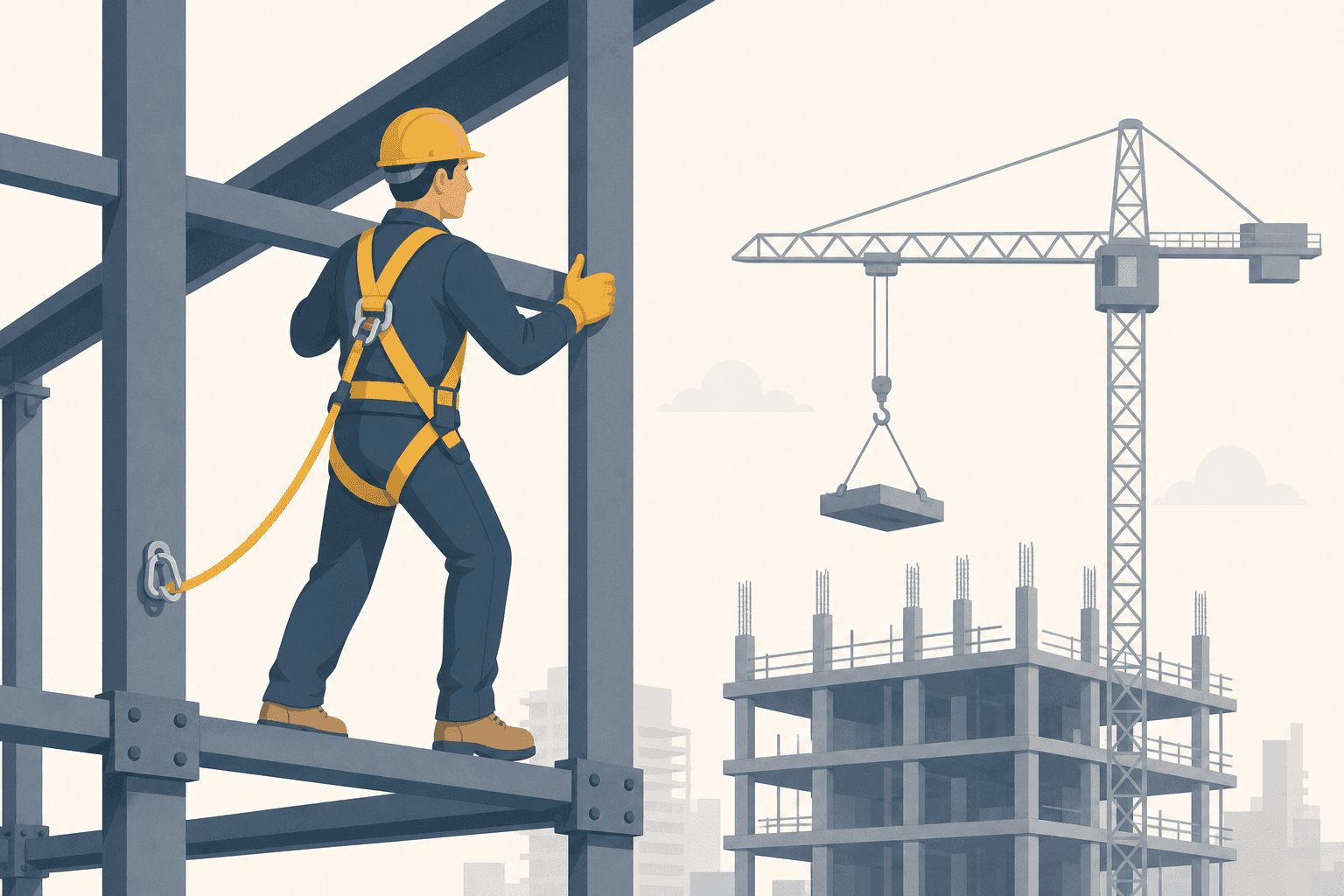
What a SWMS is — and when it's required
A Safe Work Method Statement is a document that identifies the high-risk construction work (HRCW) being carried out, the hazards it creates, and how the risks will be controlled. Under the model Work Health and Safety (WHS) Regulations, a person conducting a business or undertaking (PCBU) must prepare a SWMS before high-risk construction work begins.
There are 18 categories of high-risk construction work. If your work falls into any of them, a SWMS is legally required — and the work must be carried out in accordance with it. The SWMS must be kept on site, be readily accessible, and be reviewed whenever the work or conditions change.
Common high-risk construction work
A SWMS is required for any of the 18 HRCW categories. These are among the most common.
Risk of a fall > 2m
Any work where a person could fall more than two metres — one of the most common triggers.
Near powerlines or services
Work in the vicinity of energized electrical installations or overhead/underground services.
Confined spaces
Entry into or work within a confined space, with its risks of atmosphere and entrapment.
Demolition & asbestos
Structural demolition, and any work involving or likely to disturb asbestos.
Mobile plant & traffic
Work involving powered mobile plant, or on or near roads and traffic corridors.
Excavation & trenches
Trenches or shafts deeper than 1.5m, and tunnels — with the risk of collapse.
What a SWMS contains
RiskForms builds a SWMS with the risk-rated structure Australian regulators expect — each step scored before and after controls on a 5×5 matrix.
| Column | What goes in it |
|---|---|
| Job step | Each sequential phase of the task, broken into a handful of granular steps. |
| Potential hazards | The specific hazards that could realistically cause harm during that step. |
| Initial risk | The risk rating before controls, scored on a 5×5 likelihood × consequence matrix. |
| Preventive controls | The preventive controls, chosen using the hierarchy of controls. |
| Residual risk | The risk rating after controls are applied — it should be lower than the initial score. |
WHS law by state & territory
Australia's WHS laws are model laws enacted by each state and territory. Most mirror the model WHS Act, but Victoria runs its own OHS Act and Western Australia its own 2020 WHS Act. RiskForms applies the correct citation for the region you choose.
| Region | Governing legislation | Regulator |
|---|---|---|
| New South Wales | Work Health and Safety Act 2011 (NSW) + WHS Regulation 2017 | SafeWork NSW |
| Victoria | Occupational Health and Safety Act 2004 (Vic) + OHS Regulations 2017 | WorkSafe Victoria |
| Queensland | Work Health and Safety Act 2011 (Qld) + WHS Regulation 2011 | Workplace Health and Safety Queensland |
| Western Australia | Work Health and Safety Act 2020 (WA) + WHS (General) Regulations 2022 | WorkSafe WA |
| South Australia | Work Health and Safety Act 2012 (SA) + WHS Regulations 2012 | SafeWork SA |
| Tasmania | Work Health and Safety Act 2012 (Tas) + WHS Regulations 2022 | WorkSafe Tasmania |
| Australian Capital Territory | Work Health and Safety Act 2011 (ACT) + WHS Regulation 2011 | WorkSafe ACT |
| Northern Territory | Work Health and Safety (National Uniform Legislation) Act 2011 (NT) + WHS (NUL) Regulations 2011 | NT WorkSafe |
| Commonwealth (federally regulated) | Work Health and Safety Act 2011 (Cth) + WHS Regulations 2011 | Comcare |
Building a compliant SWMS
A SWMS follows the same logic as any risk assessment — break the job into steps, identify the hazards, rate each risk on a risk matrix, and control it using the hierarchy of controls — but it must be specific to your task and site to be valid. A generic, copy-paste SWMS is one of the most common reasons work is stopped on Australian sites.
RiskForms drafts a task-specific SWMS in seconds: describe the work, pick your state or territory, and it produces the risk-rated method statement with the correct governing law — ready for the PCBU or supervisor to review and sign.
Official guidance & sources
Always confirm the current requirements with the regulator for your region.
Related documents & guides
OSHA JHA / JSA
SWMS (Australia)Safe Work Method Statement
RAMS (UK)Risk Assessment & Method Statement
SSSP (New Zealand)Safe System of Work Plan
Job Hazard Analysis (Canada)Provincial & federal JHA
How to do a risk assessmentStep-by-step walkthrough
What is a risk assessment?Definition & legal context
Hazard identificationSpotting hazards before work
Risk matrix explained5×5 likelihood × consequence
Hierarchy of controlsElimination through to PPE
Generate your SWMS
Describe the high-risk construction work and get a complete, state-specific SWMS in seconds — ready to review and sign.
Try RiskForms free