The Hierarchy of Controls
Why the order matters
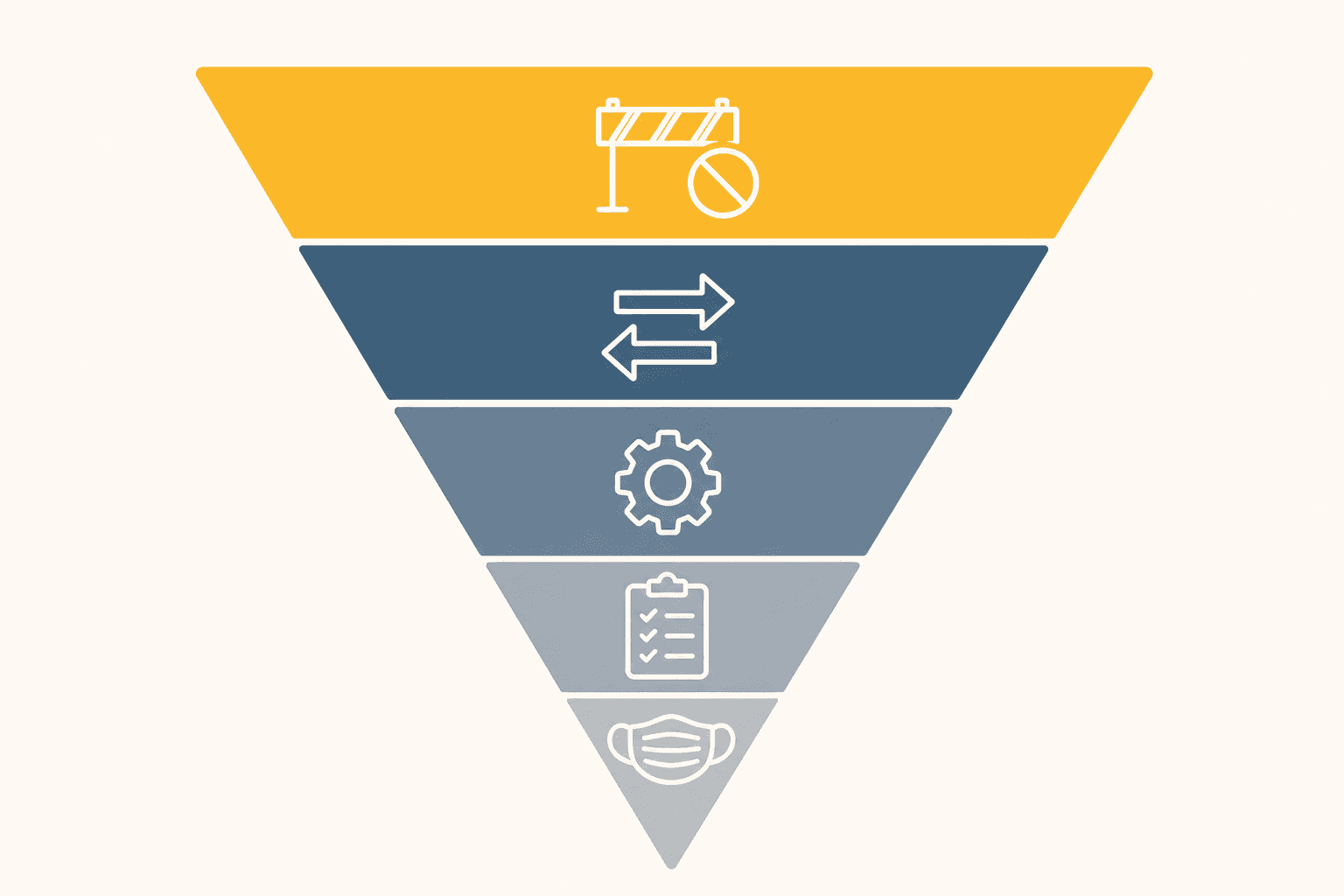
Not all safety controls are equal. Putting up a warning sign and eliminating a hazard both “address” a risk on paper, but one is far more reliable than the other. The hierarchy of controls is the internationally recognised way of ranking control measures by how effective they are — and it exists because the most tempting options are often the weakest.
The principle is simple: the higher up the hierarchy you can act, the better. Controls at the top remove or reduce the hazard itself, so they don't depend on people behaving perfectly. Controls at the bottom — signs, procedures, and PPE — rely on human behaviour every single time, which is exactly where safety systems tend to fail. You should always try to control a risk as high up the hierarchy as is reasonably practicable before falling back to a lower level.
The five levels, most to least effective
Work down this list. Only move to the next level when a higher one isn't reasonably practicable — and combine levels where you can.
- 1
Elimination — remove the hazard entirely
The most effective control: get rid of the hazard so it can't cause harm at all. Do the work at ground level instead of at height, or design out a dangerous process step. If the hazard is gone, there is nothing left to manage.
- 2
Substitution — swap it for something safer
Replace the hazard with a less dangerous alternative — a water-based solvent instead of a toxic one, or a quieter machine. The task still happens, but the potential for harm is lower.
- 3
Engineering controls — isolate people from the hazard
Physically separate people from the hazard: machine guards, ventilation and extraction, barriers, guardrails, or interlocks. These work without depending on the person, which is why they sit above the behavioural controls.
- 4
Administrative controls — change the way people work
Procedures, safe systems of work, training, signage, permits, job rotation, and scheduling noisy work for quiet periods. Useful and often necessary, but they rely on people following them consistently, so they are not a substitute for the levels above.
- 5
PPE — protect the individual as a last line
Hard hats, gloves, respirators, hearing protection, and harnesses. PPE only protects the wearer, only works when worn correctly, and does nothing to reduce the hazard itself — so it is the *last* line of defence, not the first.
The hierarchy applied to one hazard
Here's how the five levels play out for a single, common hazard — welding fume in a workshop. In practice you often use several levels together.
| Level of control | How it works | Example — welding fume |
|---|---|---|
| Elimination | Remove the hazard from the task altogether. | Use a bolted or bonded joint so no welding is required. |
| Substitution | Swap in a process or material that produces less harm. | Choose a welding process or consumable that generates less fume. |
| Engineering | Isolate people from the hazard with physical measures. | Local exhaust ventilation (fume extraction) at the weld point. |
| Administrative | Change how and when the work is done. | Limit exposure time, train welders, and restrict access to the bay. |
| PPE | Protect the individual as the last line. | Supplied-air or powered respirators for the welder. |
Common mistakes
Most weak control choices come down to reaching too low on the hierarchy, too soon.
Jumping straight to PPE
PPE is visible and cheap, so it's tempting to start there. But it's the least reliable control — always look higher first.
A sign instead of a fix
A warning sign is an administrative control. It informs people of a hazard but does nothing to reduce it. Use it to support stronger controls, not replace them.
Treating levels as either/or
The best outcomes usually stack several levels — for example, extraction (engineering) plus training (admin) plus a respirator (PPE).
Set and forget
Controls degrade: guards get removed, filters clog, procedures drift. Re-check them whenever you review the assessment.
Where the hierarchy fits in a risk assessment
The hierarchy of controls is the engine behind step three of a risk assessment — *deciding on precautions*. Once you have identified the hazards and scored each one on a risk matrix, you use the hierarchy to choose controls that bring the residual risk down as far as is reasonably practicable.
RiskForms builds this in: when it drafts your assessment it proposes controls that start at the top of the hierarchy, so your document reflects best practice rather than defaulting to “wear PPE.”
Keep reading
Step-by-step walkthrough
What is a risk assessment?Definition & legal context
Hazard identificationSpotting hazards before work
Risk matrix explained5×5 likelihood × consequence
Hierarchy of controlsElimination through to PPE
Job Hazard Analysis (US)OSHA JHA / JSA
SWMS (Australia)Safe Work Method Statement
RAMS (UK)Risk Assessment & Method Statement
SSSP (New Zealand)Safe System of Work Plan
Job Hazard Analysis (Canada)Provincial & federal JHA
Put stronger controls in your next assessment
Describe the job and RiskForms drafts a region-specific risk assessment with controls ranked by the hierarchy — ready to review and sign.
Try RiskForms free