Hazard Identification
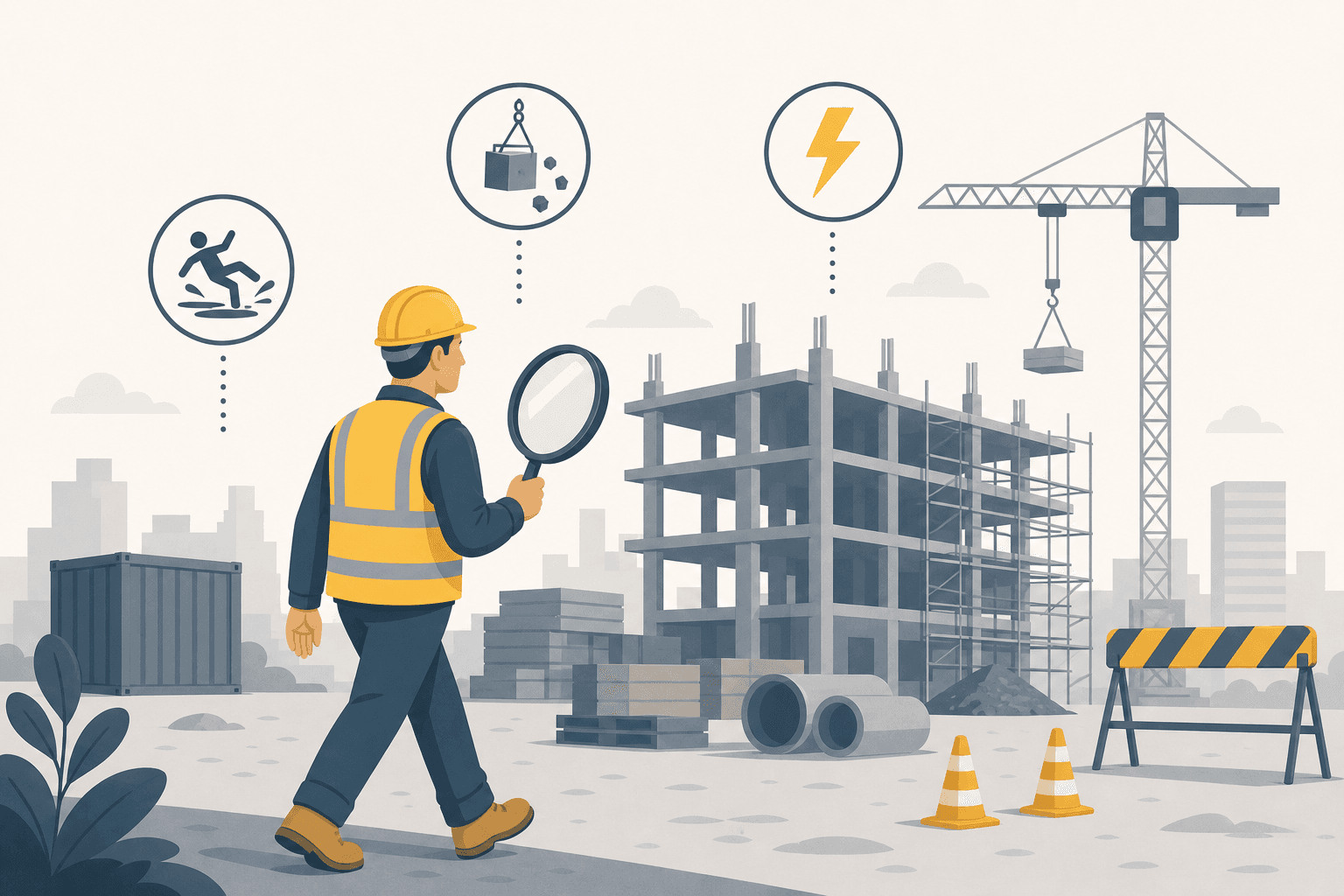
Hazard vs risk
It's worth being precise about the words. A hazard is anything with the potential to cause harm — a moving vehicle, a chemical, a trailing cable, working at height. Risk is the chance that the hazard actually hurts someone, and how badly. Hazard identification is simply the act of finding all the hazards *before* you judge the risk or decide on controls.
Get this step wrong and everything downstream is built on sand: you can't score a risk you never listed, and you can't control a hazard you never saw. That's why a good assessment starts with a deliberate, structured hunt for hazards rather than a copied template.
The main types of hazard
Running through these categories on site is a reliable way to make sure nothing is missed.
Physical & mechanical
Working at height, moving plant and vehicles, machinery, falling objects, slips and trips, and confined spaces.
Electrical & energy
Live electrical work, stored energy, hot works, pressure systems, and anything that must be isolated before work.
Chemical
Dusts, fumes, gases, solvents, and hazardous substances — anything covered by a safety data sheet.
Biological
Bacteria, viruses, mould, and contaminated materials, common in healthcare, water, and waste work.
Ergonomic
Manual handling, repetitive tasks, awkward postures, and poorly designed workstations.
Psychosocial & environmental
Fatigue, stress, lone working, violence, plus heat, cold, noise, and poor lighting.
How to find hazards
A hazard hunt is more than a walk-around. Use several of these methods together for the fullest picture.
- 1
Walk the workplace
Physically observe the task where it happens. Watch the work being done, and look at routine *and* non-routine activities — including maintenance, cleaning, set-up, and what happens when something breaks.
- 2
Talk to the people who do the job
The crew on the tools know the shortcuts, the near-misses, and the awkward steps. They will name hazards a checklist never will — so involve them directly.
- 3
Check manufacturer and product information
Equipment manuals and safety data sheets (SDS) spell out the hazards of specific machines and substances, along with the manufacturer's required precautions.
- 4
Review incidents and near-misses
Past accident records, near-miss reports, and maintenance logs point straight at hazards that have already bitten — the strongest evidence you have.
- 5
Think beyond the obvious
Consider long-term health hazards (noise, dust, vibration), rare events, and people who don't do the job every day — visitors, contractors, and new or young workers.
From hazards to a finished assessment
Once your hazards are listed, the rest of the assessment follows: decide who could be harmed and how, score each risk on a risk matrix, and choose controls using the hierarchy of controls. If you're new to the full process, start with our step-by-step guide on how to do a risk assessment.
This is also where RiskForms saves the most time: describe your task and it suggests the hazards typical of that work — a strong, structured starting point that a competent person can then confirm, trim, and add to based on what they actually see on site.
Keep reading
Step-by-step walkthrough
What is a risk assessment?Definition & legal context
Hazard identificationSpotting hazards before work
Risk matrix explained5×5 likelihood × consequence
Hierarchy of controlsElimination through to PPE
Job Hazard Analysis (US)OSHA JHA / JSA
SWMS (Australia)Safe Work Method Statement
RAMS (UK)Risk Assessment & Method Statement
SSSP (New Zealand)Safe System of Work Plan
Job Hazard Analysis (Canada)Provincial & federal JHA
Start with the hazards, finish with a document
Describe the job and RiskForms drafts the likely hazards and controls in your region's format — ready for a competent person to review and sign.
Try RiskForms free