The Risk Assessment Matrix Explained
What a risk matrix is
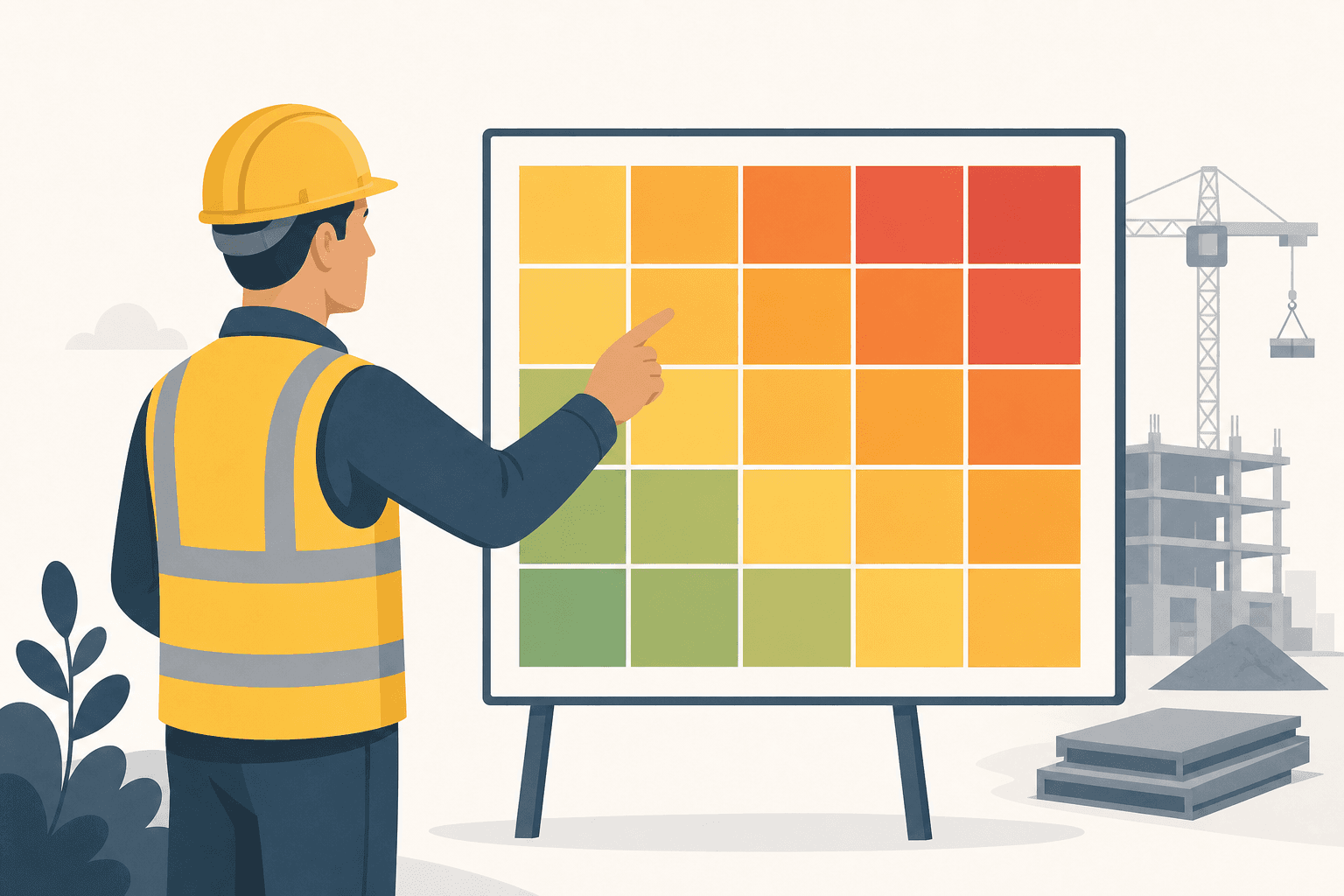
A risk matrix (or risk assessment matrix) is a grid used to rate and rank risks. One axis is the likelihood that a hazard causes harm; the other is the consequence — how serious that harm would be. Where the two meet gives a risk score, and that score maps to a colour band, from low (green) to extreme (red).
The most common format is the 5×5 matrix: five levels of likelihood and five of consequence, producing a score from 1 to 25. It is popular because it is detailed enough to separate real priorities but simple enough to use on site in seconds. RiskForms uses exactly this 5×5 model.
The likelihood scale
How probable is it that the hazard actually causes harm, given the work and the controls in place?
| Score | Rating | What it means |
|---|---|---|
| 1 | Rare | Would only happen in exceptional circumstances. |
| 2 | Unlikely | Could happen, but not expected. |
| 3 | Possible | Might happen at some point. |
| 4 | Likely | Will probably happen at some point. |
| 5 | Almost certain | Expected to happen, often or repeatedly. |
The consequence scale
If the harm did occur, how severe would the outcome be for the people affected?
| Score | Rating | What it means |
|---|---|---|
| 1 | Insignificant | No injury or first aid only. |
| 2 | Minor | Minor injury needing basic medical treatment. |
| 3 | Moderate | Injury requiring medical treatment or lost time. |
| 4 | Major | Serious injury or long-term health effect. |
| 5 | Catastrophic | Fatality or permanent disability. |
The 5×5 matrix and score bands
Multiply likelihood by consequence (each 1–5) to get a score from 1 to 25, then read off the band. Expand the matrix below to see exactly how every cell is coloured.
How risk ratings & colours are calculatedShow matrix
Each row is scored likelihood × consequence (each 1–5), giving a score from 1 to 25. The score maps to a band and colour. We score risk before controls (initial) and after controls (residual).
| Consequence → | |||||
|---|---|---|---|---|---|
| 1 Insignificant | 2 Minor | 3 Moderate | 4 Major | 5 Catastrophic | |
| 5 Almost certain | 5 | 10 | 15 | 20 | 25 |
| 4 Likely | 4 | 8 | 12 | 16 | 20 |
| 3 Possible | 3 | 6 | 9 | 12 | 15 |
| 2 Unlikely | 2 | 4 | 6 | 8 | 10 |
| 1 Rare | 1 | 2 | 3 | 4 | 5 |
↑ Likelihood. Rows top-to-bottom run 5 (almost certain) down to 1 (rare).
How to read the score
The score is simply likelihood × consequence. A hazard that is *possible* (3) and would be *major* (4) scores 12; one that is *almost certain* (5) and *catastrophic* (5) scores the maximum of 25. Those scores fall into four bands: Low (1–3), Moderate (4–6), High (7–12), and Extreme (13–25) — which is why the top-right corner of the grid is red and the bottom-left is green.
Crucially, you score each risk twice: once *before* controls (the initial risk) and once *after* your controls are in place (the residual risk). The drop between the two is the evidence that your controls actually work. A good assessment shows a high initial score falling to a low residual score once the hierarchy of controls has been applied.
Using a matrix well
A matrix is a tool for thinking, not a substitute for it. Keep these in mind.
Be consistent
Agree what each rating means before you start, so the same hazard gets the same score whoever assesses it. Shared definitions matter more than the exact numbers.
Score residual risk too
The initial score justifies action; the residual score proves the controls brought the risk down to an acceptable level.
Don't hide behind the number
A neat score of 6 can mask a genuinely dangerous task. Use judgement — if something feels unsafe, treat it that way.
Prioritise, then act
The point of ranking risks is to tackle the reds and oranges first. A matrix that never changes what you do is just decoration.
Where the matrix fits
Scoring risk is the third step of a risk assessment — after you've identified the hazards and before you finalise controls. For the full sequence, see how to do a risk assessment.
RiskForms scores every line of your assessment on this exact 5×5 matrix automatically, showing both the initial and residual risk in the correct colour band — so the ranking is done for you and stays consistent across every document.
Keep reading
Step-by-step walkthrough
What is a risk assessment?Definition & legal context
Hazard identificationSpotting hazards before work
Risk matrix explained5×5 likelihood × consequence
Hierarchy of controlsElimination through to PPE
Job Hazard Analysis (US)OSHA JHA / JSA
SWMS (Australia)Safe Work Method Statement
RAMS (UK)Risk Assessment & Method Statement
SSSP (New Zealand)Safe System of Work Plan
Job Hazard Analysis (Canada)Provincial & federal JHA
See the matrix in action
Describe your task and RiskForms scores each risk on a 5×5 matrix — initial and residual — in your region's format, ready to review and sign.
Try RiskForms free